
Biotech investing recovery defined by discipline


For three years, biotech investors were told to wait for the cycle to turn. Now that it has, the more interesting question is not whether the recovery is real — it is — but why this one looks so unlike the last.
The numbers tell a story of selective vitality rather than indiscriminate exuberance.
After a year split brutally in two: a first half frozen by tariff shocks and regulatory upheaval, and a second half that reopened the capital markets with surprising force, the momentum has carried.
In the first quarter of 2026 alone, six biopharma IPOs raised $1.8 billion — more than all of 2025 combined — while biopharma M&A added $15.6 billion across 19 transactions and licensing deals reached $77 billion in announced value.
Rate cuts have done their part; with the Federal Reserve having eased three times in 2025 and more cuts forecast, the long-duration math of drug development finally works again.
But anyone who lived through 2021 should resist the temptation to call this a rerun. The defining feature of this market is concentration, not breadth. Capital is flowing decisively toward later-stage, de-risked assets: in 2025, later rounds attracted nearly twice the dollars of seed and Series A combined.
The IPO window is open, but it is a door with a bouncer — investors are discerning, catalyst-driven, and unforgiving of stories without data. Median acquisition premiums for venture-backed biotechs ran around 62% above the last private round, which explains why M&A, not the public markets, remains the exit that anchors the entire venture ecosystem. The roughly $228 billion in pharma M&A in 2025 — driven by a patent cliff that will strip hundreds of billions in revenue from big pharma through the decade's end — is the true engine of liquidity, and it is structural, not cyclical.
This discipline is healthy. It is also creating distortions worth naming.
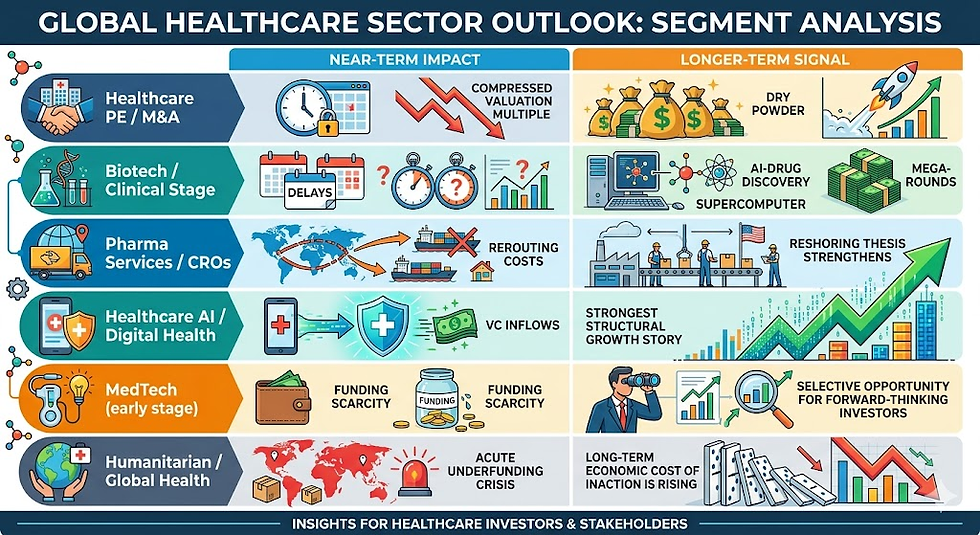
First, the early-stage funding gap. When everyone crowds into Phase 2 assets with validated mechanisms, the seed-stage science that produces the next decade's medicines goes underfunded. The "NewCo" model — assets purpose-built by specialist VCs, often around China-origin molecules licensed at attractive economics — is partially filling the void, but it favors engineering over discovery. A market that only rewards de-risked assets eventually runs out of assets to de-risk.
Second, the AI question has matured from hype to an underwriting problem. Isomorphic Labs raising $2.1 billion this year signals that capital believes AI-native drug design is a category, not a feature. The honest position is that high-performing models are not yet revenue-producing products; the inflection point is operational integration into pipelines that deliver clinical wins, and that proof remains a few years out. Investors should price AI platforms as options on productivity, not as productivity itself.
Third, geopolitics is now a permanent line item in diligence. BIOSECURE-style restrictions, most-favored-nation pricing debates, tariff exposure in supply chains, and the growing reliance on China-origin assets create a paradox: the same cross-border arbitrage that makes deals attractive makes portfolios fragile. The sophisticated response is not retreat but structuring — jurisdictional diversification, supply-chain redundancy, and a clear-eyed view of which assets carry political beta.
For long-term allocators — family offices and institutions with genuinely patient capital — this environment is arguably the most attractive entry point in a decade. Valuations remain reasonable relative to 2021, the exit machinery is functioning, and the scientific substrate
(in vivo cell therapy, neurology's reawakening, RNA medicines) is the richest it has ever been. The contrarian opportunity sits precisely where the crowd is thinnest: early-stage novel biology, funded with the patience that crossover tourists no longer possess.
The lesson of the last cycle was that abundance breeds carelessness. The lesson of this one may be the opposite: that discipline, applied too uniformly, leaves the best science orphaned. The investors who do well from here will be those who hold both truths at once — rigorous on entry price and clinical risk, but willing to fund the unvalidated idea that everyone else's screening criteria exclude. That is, after all, where venture returns have always lived.

Comments